
How much fabric for pants? Check width and every piece
Long trouser pieces can fit beside one another or need extra rows. Fabric width matters, but clothing size and leg length alone don't produce a cutting plan.
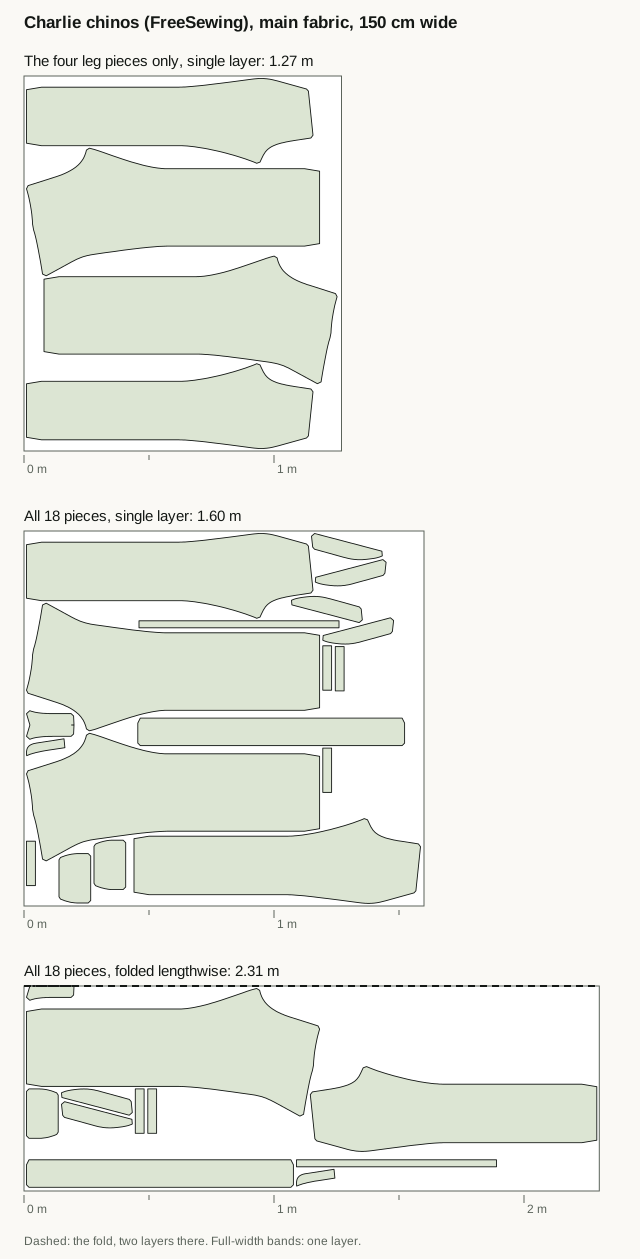
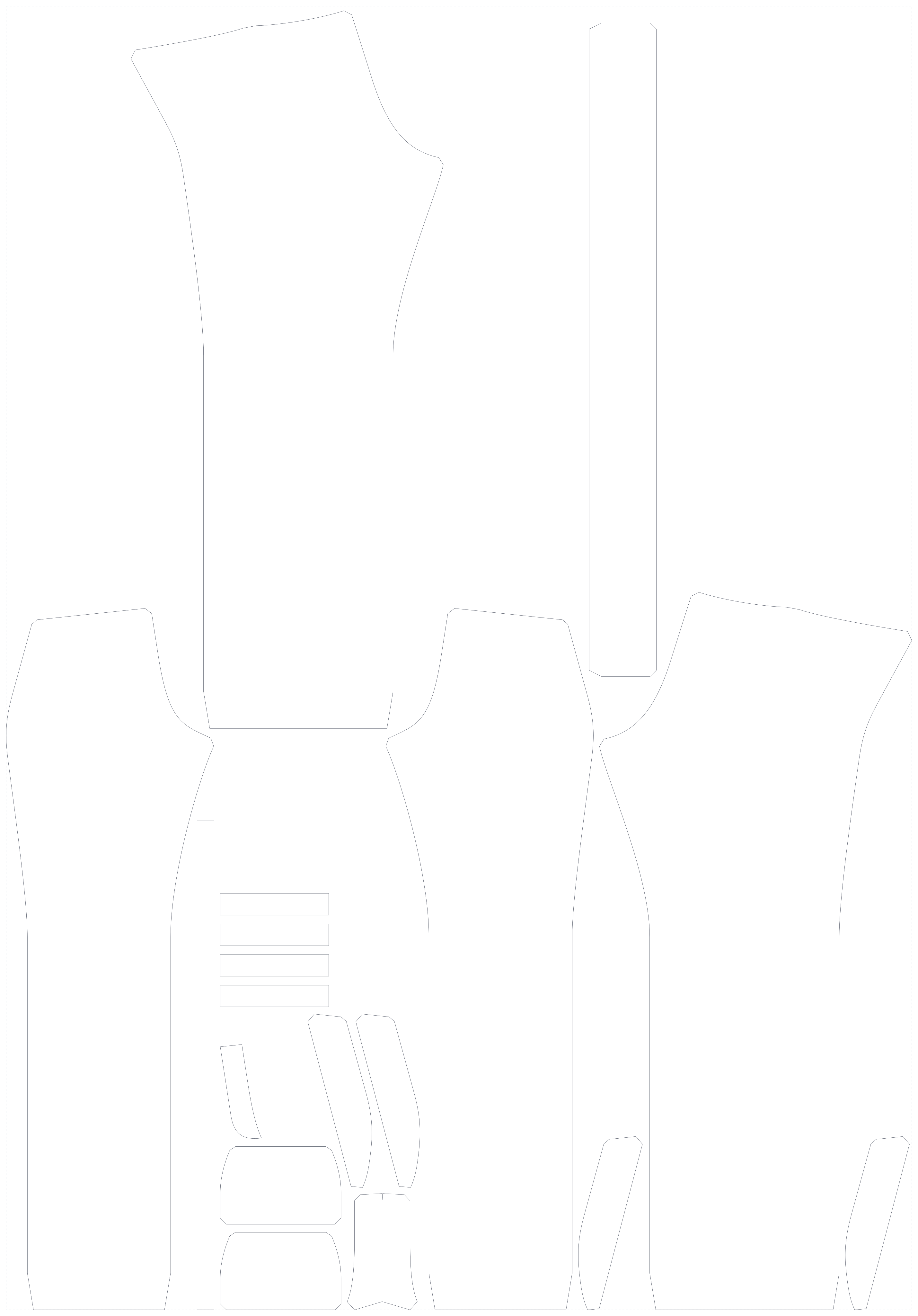
Count every front and back with its allowances, plus waistband, facings and belt loops. Computed for FreeSewing's Charlie chinos (18 pieces, single layer): 2.32 m on 110 cm, 2.09 m on 140 cm, 1.60 m on 150 cm and 1.54 m on 160 cm. Folded selvage to selvage they need 2.31 m on 150 cm, because front and back no longer fit side by side.
A computed example: chinos on four fabric widths
To put numbers on the side-by-side test, I calculated the main fabric of a real pattern: the Charlie chinos from FreeSewing, designed and programmed by Joost De Cock and open source under the MIT license. I exported Charlie with FreeSewing 4.10.2, the sample measurements "cisMaleAdult42" and 10 mm seam allowance, and laid it out in PatternNest, the tool I build. Margin 1 cm at the selvages, 1 cm between pieces.
The main fabric has 18 pieces: two fronts (115 cm long, 34 cm at the widest), two backs (117 cm long, 51 cm across the crotch), a straight waistband 107 cm long and 11 cm wide that runs along the grain, four front pocket facings, two back pocket facings, four welts, the fly facing, the fly extension (cut on the fold) and one strip for the belt loops. FreeSewing plans about 1.5 m of main fabric plus 30 cm of lining for the pocket bags, without naming a fabric width.
| Fabric width | Legs only | All 18 pieces | All 18 pieces, one way | All 18, folded |
|---|---|---|---|---|
| 110 cm | 2.32 m | 2.32 m | 2.33 m | 2.53 m |
| 140 cm | 1.54 m | 2.09 m | 2.23 m | 2.32 m |
| 150 cm | 1.27 m | 1.60 m | 2.15 m | 2.31 m |
| 160 cm | 1.20 m | 1.54 m | 1.58 m | 2.18 m |
Single layer unless noted. Grainline mode: pieces may turn 180 degrees. One way: every piece points the same direction, for nap or a one-way print. Folded: selvage to selvage, as the fold planner lays it.
What the legs alone need
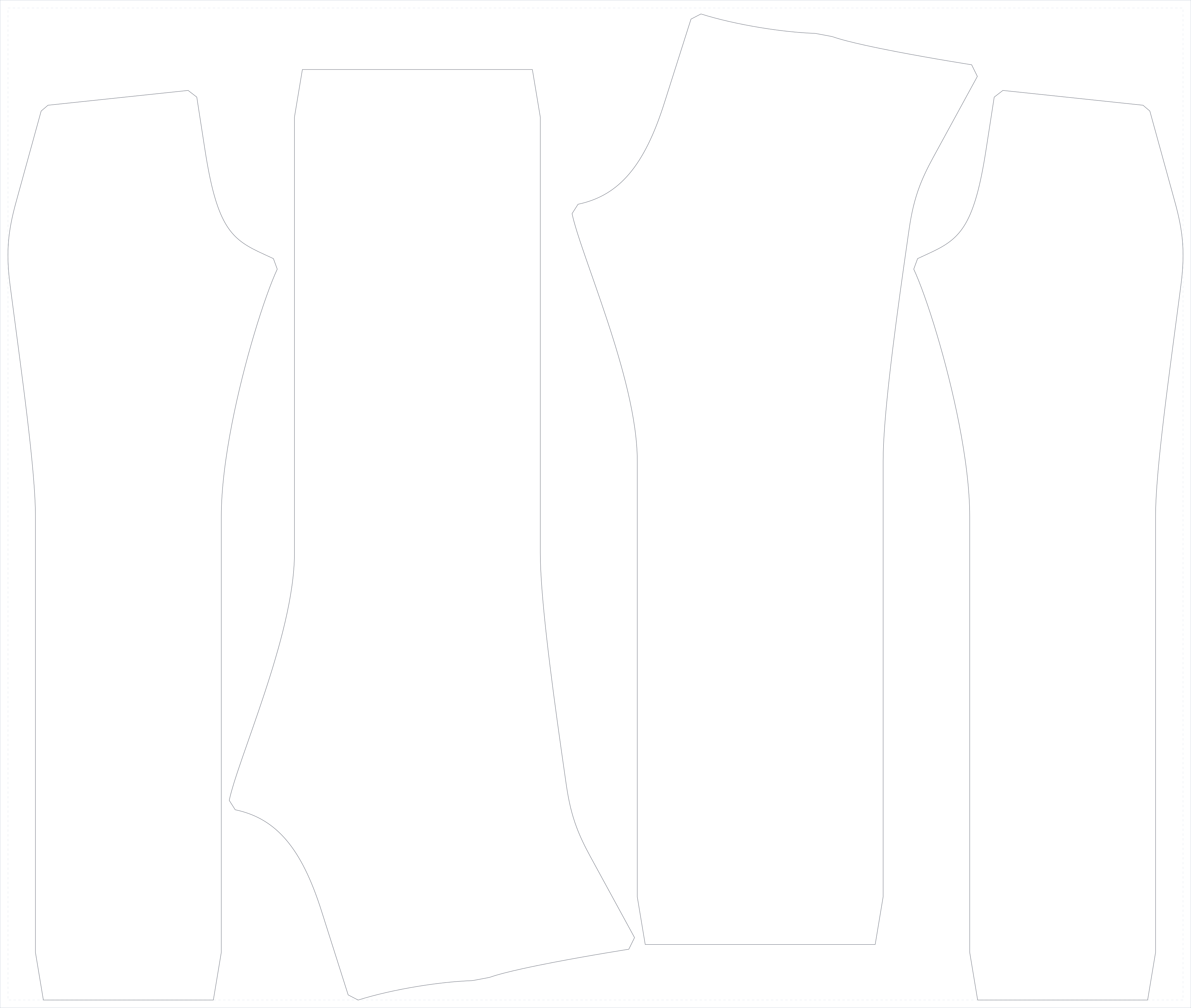
On 150 cm fabric the four leg pieces fit next to each other across the open fabric: 1.27 m, hardly more than one leg length. On 160 cm it is 1.20 m. On 140 cm they no longer fit in one row and need 1.54 m; on 110 cm only two fit across, and it is 2.32 m.
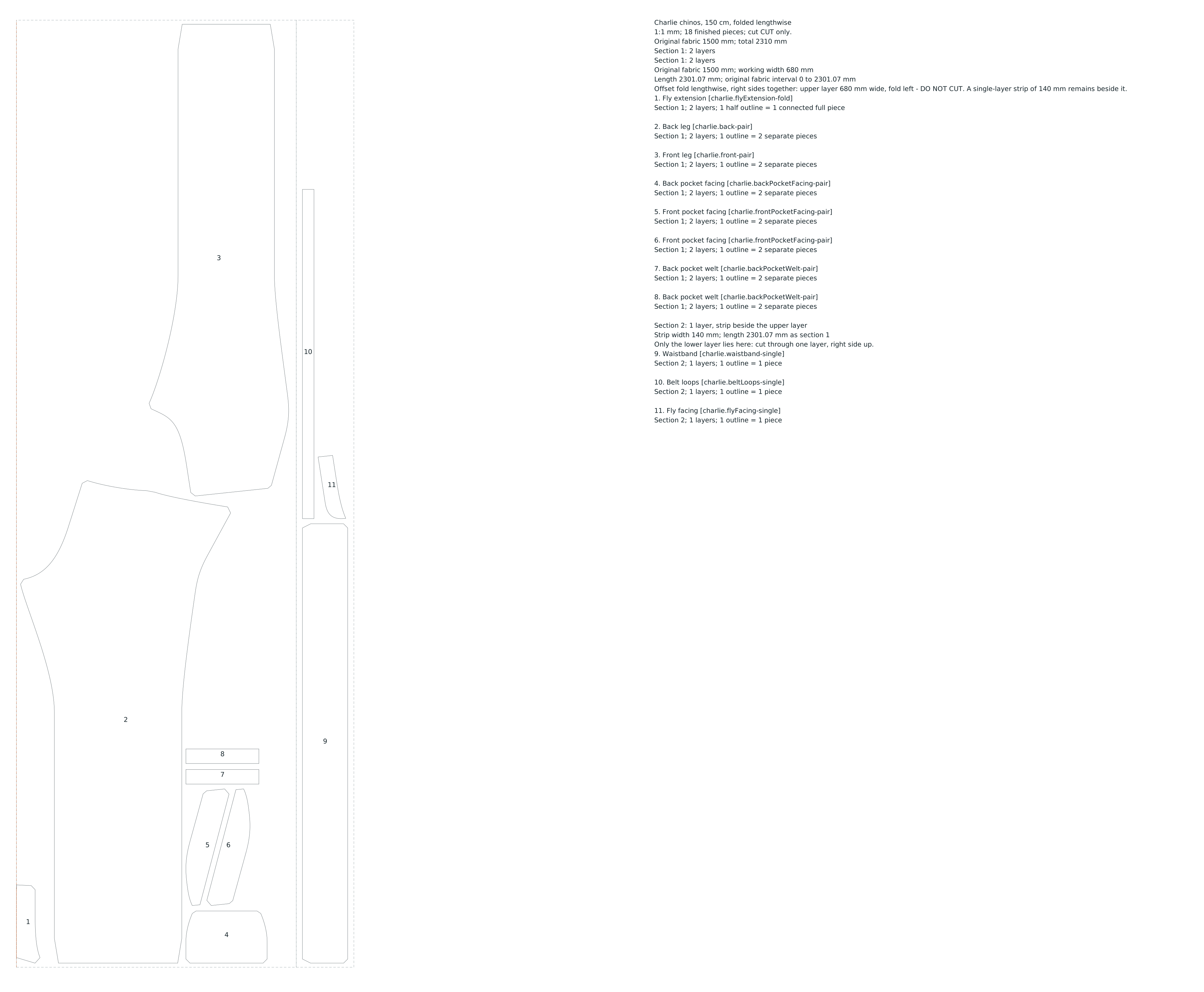
Folded selvage to selvage, the same 18 pieces need 2.31 m on 150 cm. The folded fabric is 75 cm wide, but a front and a back side by side need 85 cm at the hip, so the leg pairs lie one behind the other. For these chinos a single layer saves 71 cm. When you choose "Folded lengthwise", PatternNest also calculates the single layer and switches to it with a note when it needs less fabric. Pieces cut on the fold are then cut whole, and the button "Cut folded instead" brings the folded plan back.
What the waistband and small pieces cost
On 150 cm all 18 pieces need 1.60 m, 33 cm more than the legs alone. Most of that is the waistband. It is 107 cm long, has to run along the grain and needs a straight lane 12 cm wide. In the plan it sits between the two backs, where their inseams leave room, and the facings, welts and the belt loop strip fill the gaps beside the legs. On 160 cm the difference is 34 cm, on 140 cm 55 cm.
With a one-way fabric no piece may turn. On 150 cm the plan then needs 2.15 m, 55 cm more. On 160 cm it costs 4 cm (1.58 m).
Download and recalculate
The .pnest files contain the pieces and settings. Open them in PatternNest with "Open .pnest" and click "Calculate layout". The SVG files are the cutting layouts at 1:1 scale as PatternNest exports them. The 18-piece plans exceed the free limit of 10 pieces; the legs-only project with four pieces calculates and exports for free.
- Charlie, all 18 pieces, 150 cm, single layer: project (.pnest)
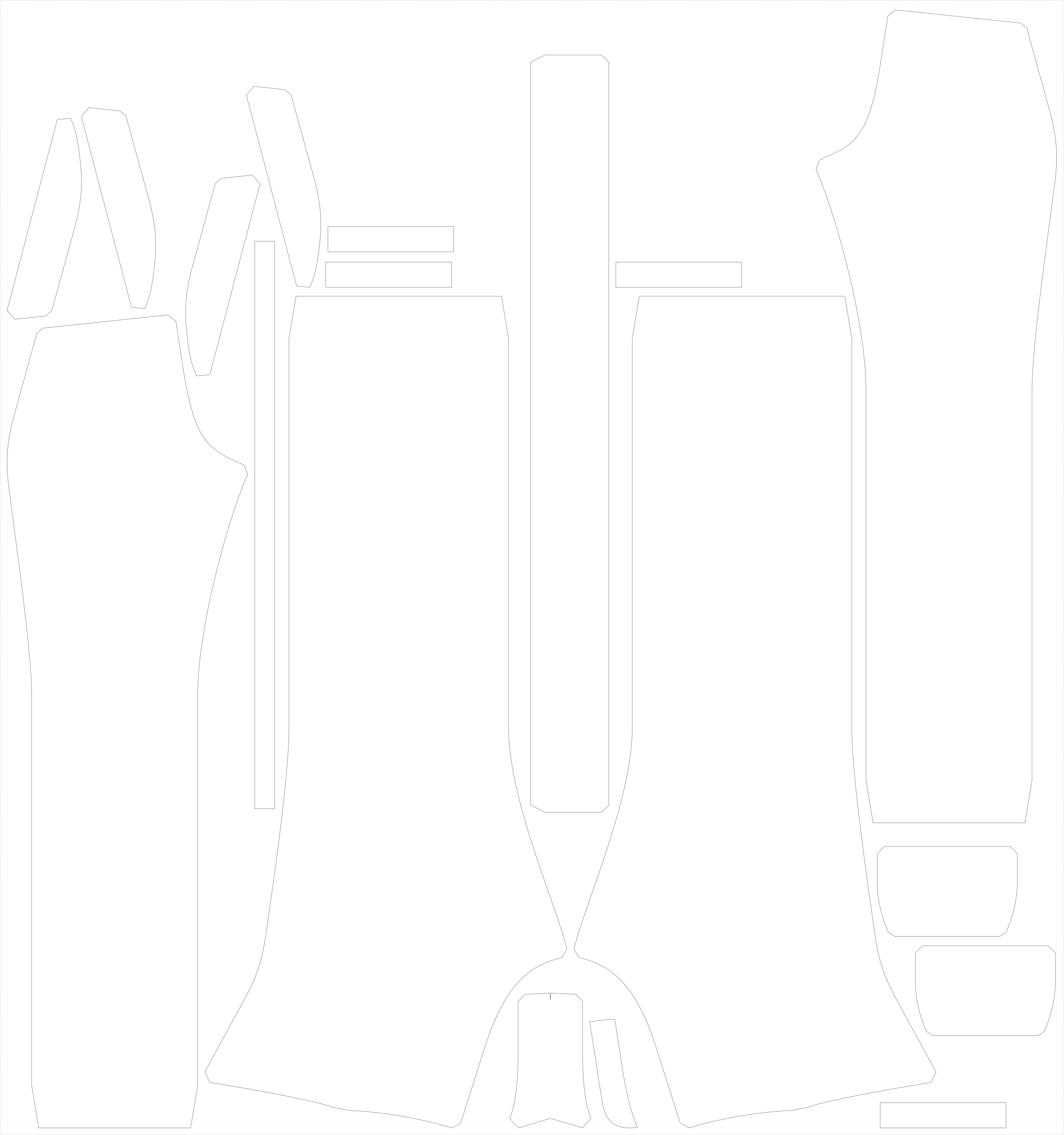
- Charlie, all 18 pieces, 150 cm: cutting layout (SVG)
- Charlie, all 18 pieces, 140 cm: project (.pnest)
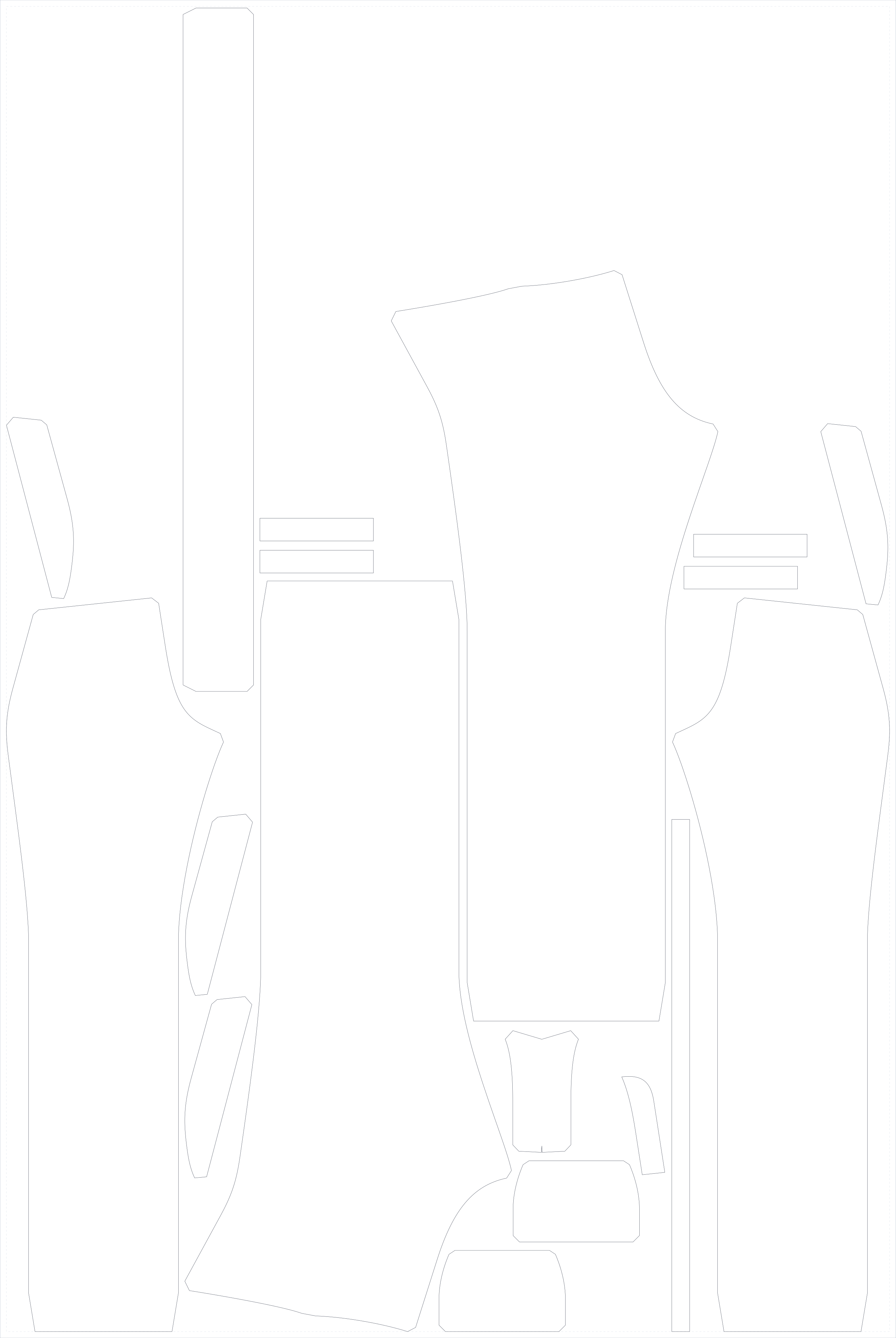
- Charlie, all 18 pieces, 140 cm: cutting layout (SVG)
- Charlie, all 18 pieces, 110 cm: project (.pnest)
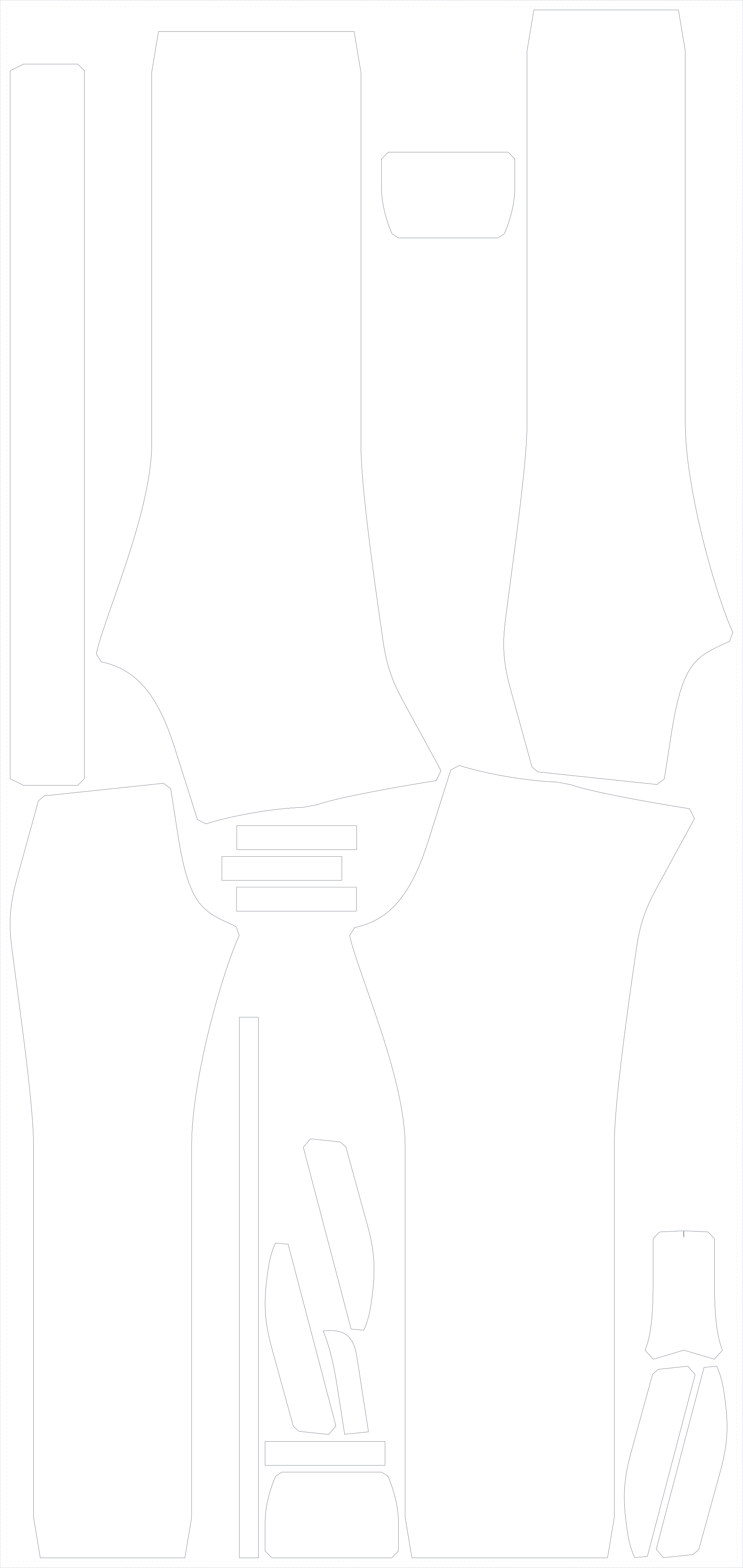
- Charlie, all 18 pieces, 110 cm: cutting layout (SVG)
- Charlie, all 18 pieces, 150 cm, one way: project (.pnest)
- Charlie, all 18 pieces, 150 cm, one way: cutting layout (SVG)
- Charlie, legs only, 150 cm: project (.pnest)
- Charlie, legs only, 150 cm: cutting layout (SVG)
- Charlie, all 18 pieces, 150 cm, folded: cutting layout (SVG)
- FreeSewing MIT license
How the numbers were checked
Each plan passed PatternNest's check on the real outlines: no overlap, at least 1 cm between pieces, everything on the fabric. I also compared the plans with each other: one way is never shorter than with turning allowed, wider fabric never longer than narrower, the legs alone never longer than all pieces, and the single layer never longer than the folded plan. All of these hold for the numbers above. They are calculated layouts for one size. Nobody cut or sewed them, so add your own reserve for shrinkage and cutting.
What the side-by-side test tells you
On folded fabric, a front and a back can each produce a mirrored pair. Whether they sit beside one another depends on their full outlines within the folded usable width. Measuring only the hem width isn't enough; the hip, crotch and pocket extensions may reach farther out.
If that arrangement doesn't fit, check a staggered or single-layer layout. The result is not automatically an exact doubling of fabric length.
There is no universal size 44 threshold
Different patterns use different measurements, ease and silhouettes. A chart with two size bands doesn't establish a sudden increase specifically between sizes 42 and 44. Check the pieces in your own size, including any length or fit adjustments.
Wide legs and stretch direction
Culottes and wide-leg trousers change the outline, not just the hem length. Leggings or sweatpants also depend on the stretch direction required by the pattern. You can't make extra fabric width useful by rotating a piece against that requirement.
Plan ribbing, pocket lining and main fabric separately. A remnant of a different material is a substitute only if it suits the pattern and construction.
Prepare the digital arrangement
Two fronts and two backs count as four fabric pieces. A mirrored pair creates left and right counterparts; increasing its quantity repeats that pair. Check the total before calculating.
Compare the resulting layout against the sewing pattern. Small components omitted from an import still belong on your shopping list.
Check the layout in PatternNest
Import closed cutting outlines from SVG, DXF or a supported vector PDF and check their dimensions. Select individual PDF pages; tiled pages are not stitched automatically. For folded fabric, mark the cut-on-fold edge. On a single layer, PatternNest unfolds that piece to its whole outline itself. Seam allowances are neither added nor removed; exported outer contours do not replace internal markings such as notches or grain arrows.
Orient the pieces according to your sewing pattern before import. Enter usable width, spacing, quantities and mirrored pairs. Grainline mode allows the prepared orientation and a 180-degree turn; one-way mode keeps the prepared orientation. The software does not test stretch or detect the fabric's actual direction.
The calculated length belongs to the returned layout. Check every placement, dimension and allowance before cutting. An incomplete search does not prove that no other arrangement fits. Repeat matching, shrinkage and defects still need a check on the cloth.
Calculation and PDF/SVG/DXF export are free for up to 10 fabric pieces, counting all copies and mirrored pieces. A mirrored pair counts as two. More than 10 fabric pieces require a license for both calculation and export.
Try your own piecesAfter the app and its assets have loaded and cached, it works offline in your browser. Your pattern files are processed locally.
Related guides
- How much fabric do I need? Check the pattern and layout
- How much fabric for a skirt? Plan panels and fullness
- How much fabric for a dress? Count the cutting pieces
- Convert fabric width by checking area and a new layout
- Guides to fabric requirements and cutting layouts
- The pattern says 2.5 yards, you have 2: will it fit?
- How much fabric for a coat or jacket
- How much fabric for pajamas, including a family set